
Brechin River Street Regeneration
29 September 2026
At a special meeting of Angus Council on 23 September 2026, councillors decided to instruct officers to progress option 3B (iii from the Options Appraisal paper.
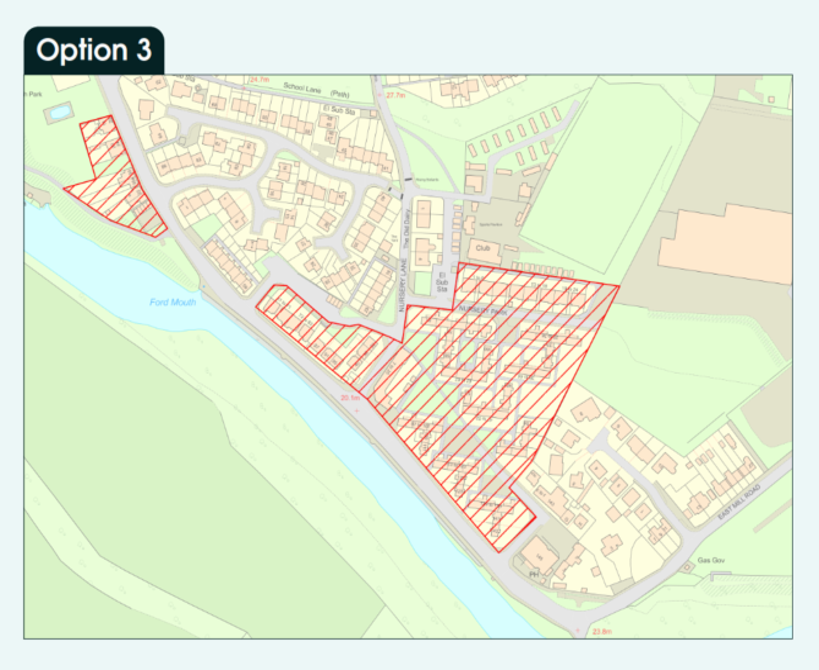
This option is selective demolition and open space, with an increase in the flood protection scheme.
It involves demolishing some existing homes and turning the land into open space, alongside improvements to the flood protection scheme.
The area covers all residential properties within the BRSA where water entered the building during Storm Babet, and the Council owns most of the properties in the block. It also includes two traditionally constructed blocks south of River Street where water entered the buildings, together with the adjacent garages.
This includes:
Residents
We understand that this decision may have a significant effect on you and cause considerable worry. We want to give you as much information as possible and will continue to support you throughout the process.
It is too early to say when demolition will take place, but it will not happen immediately.
If you are worried about where you will live, we will help you find another home, whether or not you are already a council tenant.
Angus Council tenants
If you are a tenant in one of the homes identified for demolition, your housing officer will visit you within the next four weeks to discuss your needs. They will work with you to find a suitable alternative home.
Private tenants
We will contact your landlord separately about the sale of the property. If you are worried about finding your next home, you are welcome to attend one of our drop-in sessions (see below) to arrange an appointment in your home or at another venue of your choice. Alternatively, you can contact our Housing Officer for the Brechin/Montrose Community Housing Team by email at HousingBRSA@angus.gov.uk or call Angus Council on 03452 777778.
Owner occupiers
If you own your home, we will provide you with more information on next steps in the following two weeks. If you are worried about finding your next home, you are welcome to attend one of our drop-in sessions (see below) to arrange an appointment in your home or at another venue of your choice. Alternatively, you can contact our Housing Officer for the Brechin/Montrose Community Housing Team by email at HousingBRSA@angus.gov.uk or call Angus Council on 03452 777778.
Owner landlords
We will provide you with more information on next steps in the following two weeks.
Wider BRSA residents
This decision will also affect you, as it will significantly change the look and feel of the area. We will hold community information sessions over the coming weeks (see below). We will also begin discussions about possible uses for the new open space and what it could look like in the future.
Businesses in the catchment area
Our economic development team is available to support businesses in the catchment area. You can contact the team via email at: Invest@angus.gov.uk
Help and information
This decision marks the start of a substantial programme of work to deliver the chosen option, which may take several years. We will keep you informed and give you opportunities to have your say as the work progresses.
In the short term, we have arranged the following:
- Drop-in sessions will continue every Thursday until the end of October 2026 when further dates will be announced. Communities and Housing officers will attend. You can speak privately with a housing officer or arrange an individual meeting in your home or another place of your choice.
- The next residents’ meeting will be held at JARS on 27 October at 6.30 pm for anyone who cannot attend the drop-in sessions during the day.
The Flood Protection Scheme
The Council decided to progress an increase of approximately 0.5 metres to the height of the existing Brechin Flood Defence Scheme (BFD). Some initial design work has been completed, but technical challenges remain and the scheme will still require statutory approvals.
Following this decision, we will finalise the design and begin the statutory approval process. If everything proceeds smoothly, construction could start in late 2027.
Going forward…
We will keep you informed as the work progresses through our Engage Angus: Brechin webpage, as well as by email, telephone, drop-in sessions and visits.
